As humanity embarks on a transformative chapter in space exploration, private companies are taking center stage, driving innovation and discovery far beyond what government-led programs alone could achieve. Among these pioneers is Intuitive Machines, a Houston-based space technology company that has emerged as a leader in lunar exploration, infrastructure development, and in-space services. A recent discussion on social media platforms highlighted the company’s upcoming IM-2 mission, describing it as one of the most intricate and captivating lunar endeavors since the Apollo era. This article delves deeply into the essence of Intuitive Machines—its mission, its technological contributions, and its role in the burgeoning lunar economy—while providing a comprehensive exploration of the IM-2 mission. It also reflects on the extraordinary era of private space exploration we are experiencing, drawing parallels to the age of ocean explorers who charted uncharted territories centuries ago.
What Is Intuitive Machines and What Does It Do?

Established in 2013, Intuitive Machines is a forward-thinking space exploration company incorporated in Delaware, with its stock trading on the Nasdaq under the ticker symbol LUNR. Headquartered in Houston, Texas, the company specializes in designing and deploying advanced spacecraft, lunar landers, and communication systems to facilitate scientific research, commercial ventures, and the establishment of a sustainable human presence on the Moon. Intuitive Machines is not just a contractor for space agencies; it is a visionary enterprise aiming to expand Earth’s economic and scientific sphere to include our nearest celestial neighbor.
The company gained international acclaim in February 2024 when its Nova-C class lander, named Odysseus, achieved a historic milestone: the first American spacecraft to softly land on the Moon in over 50 years, since the Apollo 17 mission in 1972. Even more notably, Odysseus became the first spacecraft to touch down in the lunar south pole region, a challenging and scientifically rich area that has captured the attention of space agencies and private entities alike. This success solidified Intuitive Machines’ position as a key partner in NASA’s Commercial Lunar Payload Services (CLPS) program, which collaborates with private companies to deliver scientific payloads to the Moon, supporting NASA’s broader Artemis program goal of returning humans to the lunar surface sustainably by the late 2020s.
Intuitive Machines’ offerings extend beyond lunar landings. The company is a leader in in-space communications, navigation, and infrastructure development, with projects like the Near Space Network Services contract, awarded in September 2024, enhancing data transmission for lunar and deep-space missions. Its Lunar Payload Delivery Services (LPDS) program opens the Moon to a wide range of customers, including government agencies, academic researchers, and commercial entities. For instance, the company has facilitated the delivery of payloads for brands like Columbia Sportswear, showcasing how the lunar surface is becoming a platform for both science and marketing innovation. Through these efforts, Intuitive Machines is not only advancing scientific knowledge but also laying the groundwork for a lunar economy where resources like water ice can be harvested, processed, and utilized for future missions.
Current and Future Missions
Intuitive Machines is deeply embedded in a series of lunar missions under NASA’s CLPS program, each designed to build on the successes of its predecessors and prepare for the Artemis program’s ambitious goal of establishing a permanent human presence on the Moon. The company’s first mission, IM-1 (Odysseus), launched in February 2024 and marked a historic achievement with its successful landing at the lunar south pole. This mission demonstrated the capabilities of the Nova-C lander and set the stage for subsequent endeavors, including the highly anticipated IM-2 mission.

Following IM-1, Intuitive Machines is now focusing on expanding its lunar footprint with a portfolio of missions that leverage advanced robotics, communication systems, and resource extraction technologies. The IM-2 mission, scheduled for launch in late February 2025, is a critical next step, targeting the lunar south pole to investigate water ice and other resources. Beyond IM-2, the company has plans for additional CLPS missions, as well as independent commercial ventures aimed at deploying lunar data relay satellites. These satellites will form a constellation around the Moon, improving communication and navigation for future missions and enabling a robust infrastructure for both government and private operations.
Looking further ahead, Intuitive Machines envisions a future where the Moon serves as a hub for scientific discovery, resource utilization, and commercial activity. The company’s long-term strategy includes developing technologies for in-situ resource utilization (ISRU), such as extracting water ice to produce oxygen, drinking water, and rocket fuel, thereby reducing the cost and complexity of deep-space exploration. These efforts align with NASA’s Artemis program and international initiatives, positioning Intuitive Machines as a key player in the global race to establish a sustainable lunar presence by the end of the decade.
In-Depth Look at the IM-2 Mission
The IM-2 mission represents a monumental leap forward in lunar exploration, driven by Intuitive Machines’ Nova-C class lunar lander, named Athena. Scheduled for a multi-day launch window opening no earlier than February 26, 2025, from Launch Complex 39A at NASA’s Kennedy Space Center in Florida, in partnership with SpaceX, IM-2 is poised to be one of the most technically sophisticated missions since the Apollo era. As of February 24, 2025, Athena has completed all integration milestones and is encapsulated within SpaceX’s payload fairing, ready for its journey to the Moon.
Mission Details and Components
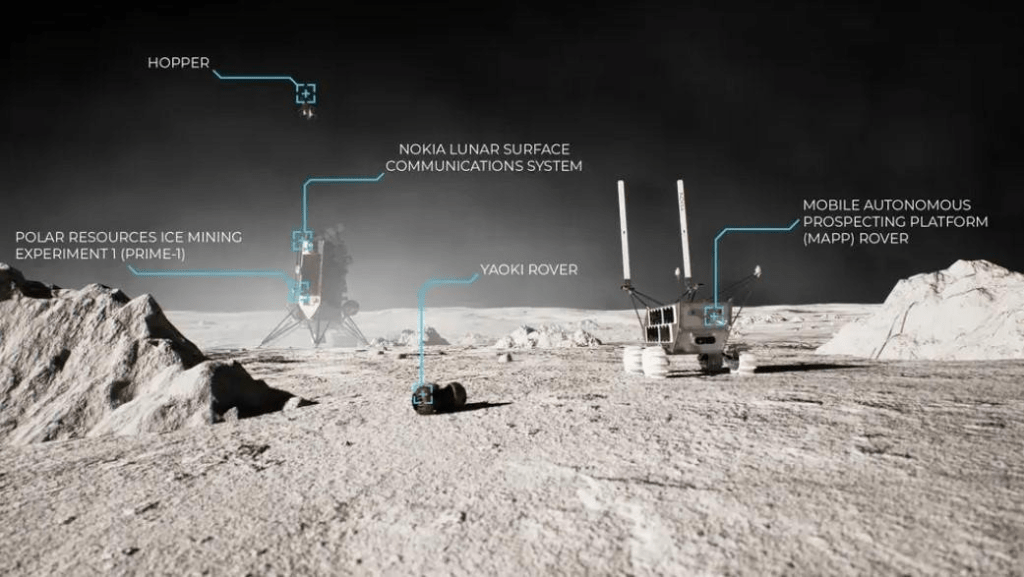
IM-2 targets the lunar south pole, a region of immense scientific and strategic importance due to its permanently shadowed craters, which may harbor significant deposits of water ice. This resource is critical for sustaining long-term human presence on the Moon, as it can be converted into drinking water, oxygen for breathing, and hydrogen for rocket fuel, reducing the need to transport these essentials from Earth. The Athena lander will carry a diverse array of payloads, including six NASA instruments and a European Space Agency (ESA)-led drill suite, designed to search for and analyze water ice beneath the lunar surface.
The mission features several advanced components, each contributing to its ambitious objectives:
- Hopper: A small, hopping robot designed for mobility across the lunar surface, allowing it to navigate challenging terrains and collect data from multiple locations.
- Nokia Lunar Surface Communications System: A state-of-the-art communication network that ensures reliable data transmission between the lander, rovers, and ground stations on Earth, critical for real-time mission operations and scientific analysis.
- Polar Resources Ice Mining: Specialized equipment to investigate and potentially extract water ice, providing insights into the feasibility of in-situ resource utilization and supporting future lunar base development.
- Mobile Autonomous Multi-Purpose Platform (MAPP) Rover: Developed by Venturi Astrolab, this versatile rover is capable of performing a wide range of tasks, from scientific research and sample collection to infrastructure support for future missions.
- Yak’i Rover: Another rover, engineered for specific scientific or operational objectives, enhancing the mission’s ability to explore and map the lunar south pole environment.
These components work in harmony to create a highly integrated and technologically advanced mission, showcasing Intuitive Machines’ ability to design and operate complex lunar systems. Additionally, the mission includes secondary payloads, such as a lunar communications satellite to facilitate ongoing communication between the lander and Earth, and the MiniPIX TPX3 SPACE payload from ADVACAM, which will monitor the Moon’s radiation environment to inform strategies for protecting crew and equipment from cosmic rays.

Current Status (As of February 24, 2025)
As the mission approaches its launch date, Athena is fully prepared, having undergone rigorous testing and integration processes. Intuitive Machines’ leadership, including CEO Steve Altemus, has emphasized the historic nature of IM-2, noting that it coincides with an unprecedented period of lunar activity, with multiple landers from private companies and international space agencies en route to the Moon simultaneously. The mission’s launch is timed to capitalize on optimal lunar trajectories, ensuring a precise landing at the south pole, where scientific data collection will begin shortly after touchdown.
Objectives and End Goal
The IM-2 mission’s primary objective is to advance our understanding of the lunar south pole’s resources, particularly water ice, while demonstrating cutting-edge technologies for lunar exploration and operations. By deploying rovers, drills, and communication systems, the mission aims to:
- Characterize the presence, distribution, and quantity of water ice in the lunar south pole’s shadowed craters, providing critical data for future resource extraction and utilization.
- Test and validate new mobility, communication, and navigation systems, ensuring they can withstand the harsh lunar environment and support sustained operations.
- Collect scientific data to support NASA’s Artemis program, which seeks to establish a long-term human presence on the Moon by the late 2020s, as well as international lunar initiatives.
- Lay the foundation for a lunar economy by demonstrating the feasibility of private-sector-led exploration, resource harvesting, and infrastructure development.
In the broader context, the IM-2 mission is a pivotal step toward creating a sustainable human presence on the Moon, enabling future missions to Mars, and unlocking commercial opportunities in space. By successfully landing and operating at the lunar south pole, Intuitive Machines aims to prove that private companies can lead the charge in humanity’s return to the Moon, complementing and accelerating government-led efforts.
You can find here the detailed video animation of the IM-2 mission, which was intricately created by the innovative team at Intuitive Machines. This fascinating animation provides not only a captivating visual representation of the mission’s objectives but also highlights the groundbreaking technology utilized throughout the journey. To deepen your understanding and appreciation of this ambitious endeavor, be sure to watch the video: Intuitive Machines IM-2 Lunar Mission Animation.
The Amazing Era of Private Space Exploration
We are living in an extraordinary time, marked by the rapid proliferation of lunar missions and the rise of private companies as key players in space exploration. What sets this era apart is the frequency and sophistication of these missions, many of which are driven by private enterprises rather than solely government agencies. This shift echoes the age of ocean explorers in the 15th and 16th centuries, when intrepid navigators like Christopher Columbus, Ferdinand Magellan, and Vasco da Gama ventured into uncharted waters, discovering new continents and opening pathways for trade, science, and colonization. Today, companies like Intuitive Machines, SpaceX, Blue Origin, and others are the modern equivalents of those explorers, boldly venturing into the final frontier with innovative technologies and ambitious visions.
The IM-2 mission exemplifies this new era. Its focus on the lunar south pole, water ice extraction, and advanced robotics underscores the transformative potential of private-sector innovation. Unlike the Apollo era, which was dominated by government-led missions with massive budgets and national prestige at stake, today’s space race is characterized by collaboration between NASA, international partners, and private entities. This partnership model is democratizing access to space, accelerating technological progress, and reducing costs, making lunar exploration more frequent and accessible than ever before.
The success of Intuitive Machines’ IM-1 mission in 2024, which marked the first American lunar landing in over 50 years, and the anticipation surrounding IM-2 in 2025, highlight the rapid maturation of private space exploration. With multiple lunar landers—both private and governmental—headed to the Moon simultaneously in 2025, we are witnessing a renaissance of discovery. This period is not only about scientific advancement but also about commercial opportunity, cultural significance, and the promise of a multi-planetary future. The lunar south pole, with its potential water ice and strategic location, is becoming a focal point for this new frontier, much like the New World was for early explorers.
Moreover, the involvement of private companies introduces a level of agility and innovation that complements traditional space agencies. Intuitive Machines’ ability to partner with NASA, the ESA, and commercial entities like Nokia and Venturi Astrolab demonstrates a collaborative ecosystem where diverse stakeholders contribute to a shared vision. This model is fostering a lunar economy, where resources can be mined, processed, and traded, paving the way for sustained human presence and interplanetary travel. It’s a thrilling time, filled with possibilities, as we watch private companies chart new territories in space, much like the ocean explorers of old who opened up new lands for humanity’s exploration and exploitation.
Conclusion
Intuitive Machines stands as a beacon of innovation in this new space age, leveraging its expertise in lunar landers, robotics, communication systems, and resource extraction to redefine the possibilities of lunar exploration. The IM-2 mission, targeting a launch in late February 2025, represents a critical milestone in the journey toward a sustainable human presence on the Moon. With its focus on the lunar south pole, water ice, and advanced technologies, IM-2 is not only a scientific endeavor but also a commercial and cultural landmark, signaling the dawn of a lunar economy driven by private enterprise.
As we await the launch of Athena and the data it will collect from the lunar south pole, we are reminded of the incredible era we inhabit—where private companies are leading the charge in space exploration, complementing government efforts, and accelerating humanity’s return to the Moon. This period, marked by frequent and ambitious missions, mirrors the age of ocean exploration, when brave navigators ventured into the unknown, forever changing the course of human history. Stay informed about Intuitive Machines’ progress by following their updates on their official website and social media channels, as they continue to push the boundaries of what’s possible in space. The future of lunar exploration is bright, and Intuitive Machines is at its forefront, guiding us toward a multi-planetary future.


 Earth2Space
Leave a comment