Rocket Lab has long been a darling of the smallsat revolution, but the latest Payload Research report, “The Rocket Lab Report,” released January 15, 2025, reveals just how far this space trailblazer has come—and where it’s headed next. Sponsored by Rocket Lab itself, this 23-page deep dive dissects the company’s launch prowess, Space Systems boom, economic strides, and tantalizing R&D prospects, including whispers of an in-house satellite constellation. Let’s break it down for the space-curious, explore what it means, and peer into Rocket Lab’s starry future—complete with some cosmic visuals and handy extras!
Key Summary: Milestones and Momentum
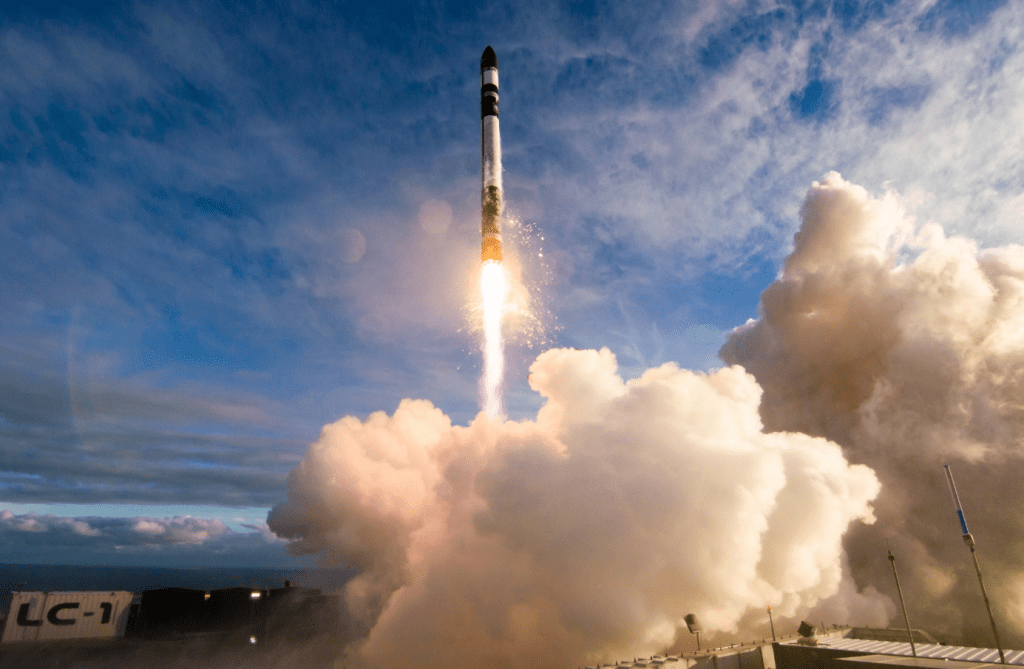
The report kicks off with Rocket Lab’s crown jewel: the Electron rocket. Since its first orbital success in 2018, Electron has notched 54 launches by late 2024, with a record 14 in that year alone—making it the second most-flown U.S. rocket annually, trailing only SpaceX’s Falcon 9. Payload capacity has doubled from 150 kg to 300 kg to low Earth orbit (LEO), thanks to iterative upgrades like enhanced Rutherford engine batteries. Reusability is no longer a dream—2024 saw a recovered first stage returned to the production line, with plans for a reflown mission imminent.
Beyond launches, Rocket Lab’s Space Systems division is stealing the show. Revenue from spacecraft, components, and services now surpasses launch earnings, driven by hefty contracts like building 18 satellites for the U.S. Space Force’s Space Development Agency (SDA) Tranche 2 Transport Layer. The Photon spacecraft, meanwhile, is racking up interplanetary cred—think lunar missions for NASA and a private Venus trip in the works. The report pegs Space Systems as Rocket Lab’s growth engine, with a backlog exceeding $1 billion by Q3 2024.
Then there’s Neutron, the medium-lift rocket set to debut in 2025. With a 13-tonne LEO capacity (15 tonnes expendable), Neutron’s development stays lean at $300 million—compare that to Falcon 9’s $390 million. Its carbon-composite body and “Hungry Hippo” fairing promise cost-effective reusability, targeting a $50 million-per-launch price tag to snag constellation deployment gigs.
The wild card? Rocket Lab might be cooking up its own LEO constellation for “data services.” The report floats this as a speculative pivot, leveraging vertical integration from acquisitions like Sinclair Interplanetary and Advanced Solutions Inc. to go from launch provider to operator.
Considerations: Triumphs, Risks, and Rivals
Rocket Lab’s strengths shine bright. Dual-hemisphere ops—launching from New Zealand and Virginia in a single day (November 2024)—flex its global reach. Electron’s 98% success rate (post-2019 setbacks) and rapid cadence prove reliability, while Neutron’s design sidesteps heavy R&D bloat plaguing giants like ULA’s Vulcan. The Space Systems surge, bolstered by SDA contracts and Photon’s versatility, positions Rocket Lab as an end-to-end player, not just a ride to orbit.
But the report doesn’t shy away from hurdles. Neutron’s mid-2025 debut could slip—flight three’s fueling milestone is promising, but rocket timelines are notoriously fickle. The smallsat market is heating up—Firefly’s Alpha and Relativity’s Terran R are nipping at Electron’s heels, while SpaceX’s rideshares undercut on price ($6,000/kg vs. Electron’s $25,000/kg). A proprietary constellation sounds juicy, but Rocket Lab must avoid alienating existing customers like BlackSky, whom it launches. Scaling a data network against Starlink’s $10 billion juggernaut is another tall order.
Economically, Rocket Lab’s a rockstar—its stock soared 100% in late 2024 to a $12 billion valuation, fueled by Neutron hype and Space Systems wins. Yet, the report cautions that space stocks are rollercoasters, and government reliance (e.g., SDA contracts) ties Rocket Lab to political winds.
Neutron Specs at a Glance
- Height: 43 meters
- Diameter: 7 meters
- Payload Capacity: 13 tonnes to LEO (reusable), 15 tonnes (expendable)
- Engines: 7 Archimedes (first stage), 1 vacuum-optimized Archimedes (second stage)
- Materials: Carbon composite
- Target Cost: $50 million per launch
- First Flight: Mid-2025 (fingers crossed!)
What’s Next: A Galactic 2025 and Beyond
So, what can we expect? Neutron’s first flight will be the biggie. A successful 2025 launch—possibly from Wallops, Virginia—could flood Rocket Lab’s order book with constellation deals, especially if reusability pans out. The report predicts 10–12 Electron launches in 2025 alongside Neutron’s ramp-up, pushing Rocket Lab’s cadence past 2024’s high-water mark. Space Systems will keep humming, with Photon eyeing Mars and Venus, and SDA satellites hitting orbit by 2026.
The constellation tease is the one to watch. CEO Peter Beck has downplayed Starlink-scale ambitions, hinting at “dozens or hundreds” of satellites for niche data services—perhaps SDA-aligned or a commercial play like Earth observation. The report suggests Rocket Lab’s supply chain control (80% in-house components) gives it a shot, but execution will be key.
For us space nerds, Rocket Lab’s 2025 feels like a sci-fi blockbuster in the making: Neutron’s roar, Electron’s relentless pace, and maybe a constellation reveal. Download the report from Payload Research—it’s a meaty read—and join me in rooting for this Kiwi-born, cosmos-bound dynamo. The final frontier’s getting crowded, and Rocket Lab’s ready to stake its claim.

Here the link to download the Full Report on Payload website: The Rocket Lab Report – Payload
 Earth2Space
Leave a comment