The Mars Sample Return (MSR) mission stands as one of the most ambitious endeavors in planetary exploration, aiming to retrieve Martian rock and soil samples and deliver them to Earth for comprehensive analysis. This initiative, primarily led by NASA in collaboration with the European Space Agency (ESA), seeks to deepen our understanding of Mars’ geological history and assess its past potential for harboring life.
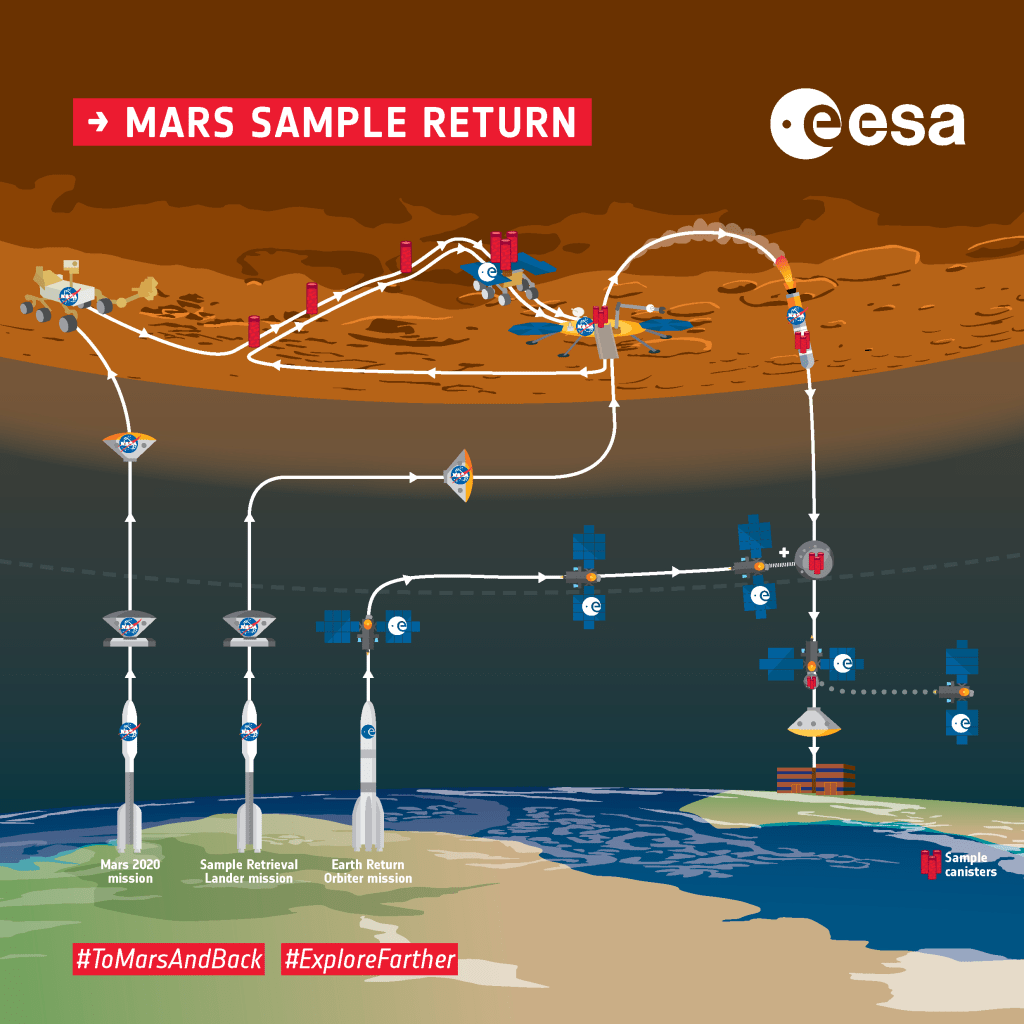
Overview of the Mars Sample Return Mission
The MSR mission is designed to collect and transport Martian samples to Earth, enabling scientists to conduct detailed laboratory analyses that are beyond the capabilities of current in-situ instruments. The mission’s architecture involves multiple stages:
- Sample Collection: NASA’s Perseverance rover, which landed on Mars in February 2021, has been diligently collecting rock and soil samples. These samples are stored in sealed, sterile titanium tubes to preserve their integrity.
- Sample Retrieval: A proposed Sample Retrieval Lander would deploy to Mars, carrying a Mars Ascent Vehicle (MAV) and a Sample Transfer Arm. The lander would retrieve the cached samples and load them into the MAV.
- Sample Return: The MAV would launch from the Martian surface, carrying the sample container into orbit. An Earth Return Orbiter, equipped with a capture mechanism, would rendezvous with the MAV, secure the sample container, and transport it back to Earth.
This intricate sequence aims to return the Martian samples to Earth by the early 2030s. However, the mission has faced challenges related to escalating costs and scheduling delays. Originally estimated at $7 billion, projections have now reached approximately $11 billion, with potential delays pushing the return date beyond 2040.
Here at the following link you can find the Mars Sample Return mission project on Rocket Lab’s website: Mars Sample Return | Rocket Lab
Rocket Lab’s Alternative Proposal

In response to these challenges, Rocket Lab, a private aerospace company known for its innovative and cost-effective solutions, has proposed an alternative architecture for the MSR mission. Their approach emphasizes accelerated timelines and reduced costs, aiming to deliver Martian samples to scientists faster and more affordably.
Rocket Lab’s CEO, Peter Beck, has been vocal about the company’s capabilities and vision for the mission. In a statement on X (formerly Twitter), Rocket Lab highlighted their commitment:
“We can wait another year, or we can get started now. Our Mars Sample Return architecture will put Martian samples in the hands of scientists faster and more affordably. Less than $4 billion, with samples returned as early as 2031.”
This proposal suggests a significant reduction in both cost and timeline compared to the current NASA-ESA plan.
Key Components of Rocket Lab’s Proposal
- Cost Efficiency: Rocket Lab estimates that their mission architecture can achieve sample return for under $4 billion, substantially less than the current $11 billion projection.
- Accelerated Timeline: The company aims to return samples by 2031, nearly a decade earlier than the revised timelines of existing plans.
- Proven Technology: Leveraging their experience with small rockets and spacecraft, Rocket Lab intends to utilize scalable and reliable technology to facilitate the mission.
Peter Beck’s confidence in Rocket Lab’s capabilities is evident in his remarks:
“I am not sure about that, we are pretty good at small rockets…”
“Or…a better 3rd option- Rocket Lab does it for billions less and years earlier using our proposed architecture.”

Advantages of Rocket Lab’s Approach
- Financial Prudence: Reducing the mission cost by more than half allows for the allocation of resources to other critical scientific endeavors.
- Timely Scientific Return: An earlier return of samples accelerates the pace of discovery, enabling scientists to analyze Martian material sooner and refine future exploration strategies.
- Industry Innovation: Rocket Lab’s involvement exemplifies how private companies can contribute to space exploration, fostering competition and driving technological advancements.
Look as well at this Business Wire article
Conclusion
The Mars Sample Return mission represents a monumental step in our quest to understand Mars and the broader solar system. While the traditional NASA-ESA plan has encountered financial and temporal hurdles, Rocket Lab’s innovative proposal offers a compelling alternative that promises to deliver scientific treasures from the Red Planet more efficiently and cost-effectively. Embracing such private-sector solutions could redefine the future of interplanetary exploration, benefiting the scientific community and humanity as a whole.
 Earth2Space
Leave a comment